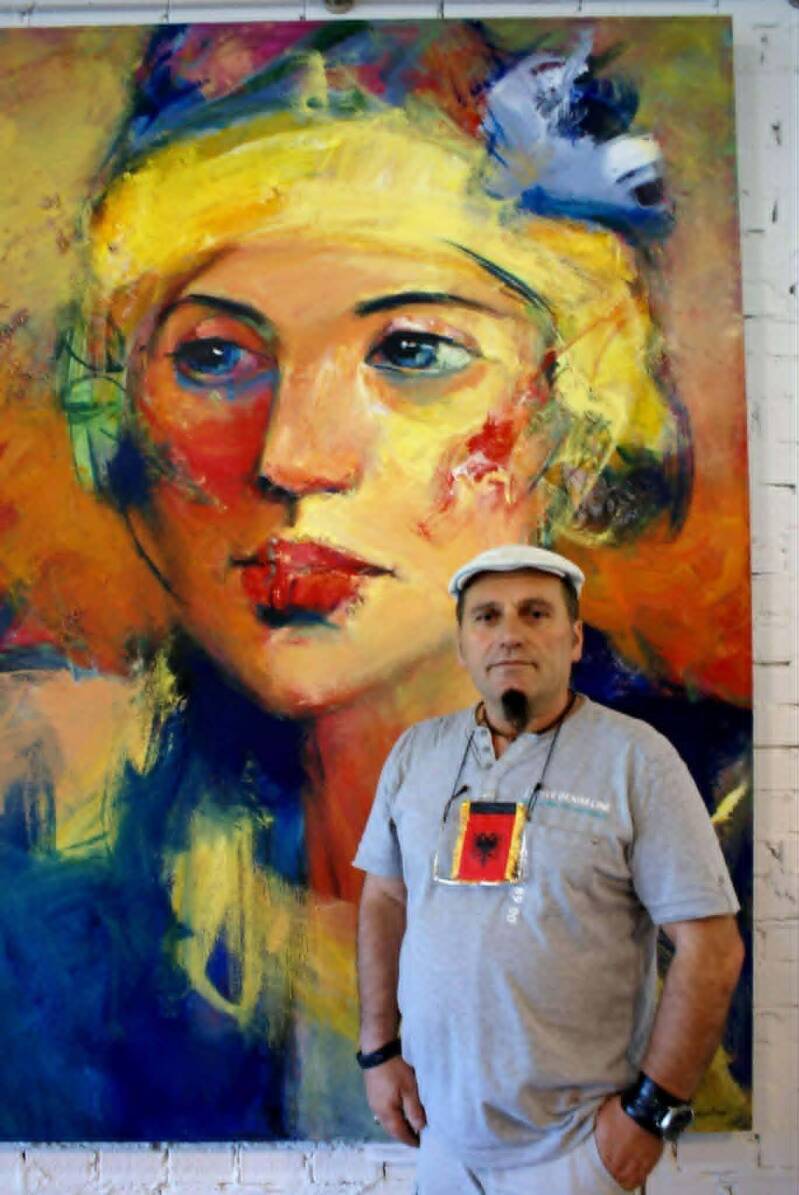
"Colors Speak, Lines Breathe: A Conversation with Shfqet Avdush Emini from the Netherlands" My artistic journey was born from a difficult ordeal, and I abandoned titles long ago === In the world of visual art, where colors converge and lines dance, Shfqet Avdush Emini from the Netherlands emerges as one of the most significant artistic voices of our time. Through his artworks that provoke thought and evoke emotions, Shfqet takes us on a journey through time, exploring the depths of humanity and expressing them with the brush.
We discuss with him topics of identity, memory, and the human condition, and discover how art can serve as a means to express feelings and ideas that cannot be expressed in words. We welcome artist Shfqet Avdush Emini in this dialogue where we explore his artistic vision, experiences, and thoughts on the role of visual art in shaping modern society. Interviewed by: Turkia loucif Algeria === We welcome you and thank you for accepting the invitation, and we begin the dialogue with a brief talk about your artistic journey.
How did it begin?
Shfqet Avdush Emini: Let’s say my artistic journey was born from a difficult ordeal, and I answer: it was born from an inner need to express something that often cannot be described in words. From the beginning, art for me was not only a form of creativity, but also a means of contemplation, exploration, and communication with the world around me. I went through different creative phases, each of which helped me understand not only through visual language, but also understand myself. In my paintings, I tried to combine personal sensitivity with collective memory, and the intimate experience with a universal dimension. That is why I say art for me is a journey that continues every day—a living, open process that constantly evolves.
You have a considerable collection of artworks. Which art school or movement do you belong to?
Shfqet: I would say I feel closest to the Expressionist movement, or more precisely, to a contemporary approach where personal expression and emotional depth are essential. In my work, elements of symbolism, inner expression, and sometimes abstraction are woven together depending on the subject and the energy each piece requires. For me, art is not just a stylistic affiliation; it is a free language that must remain authentic. Therefore, I care less about belonging to a particular “school” and more about belonging to my own artistic truth.
What is your view on the cultural heritage of Kosovo, since you are from that region, within the context of the global cultural scene?
Shfqet: Kosovo’s cultural heritage is extremely rich, deep, and multidimensional. It carries historical memory, collective spirit, pain, and resistance, but it also carries the beauty of our identity. In the context of the global cultural scene, I believe Kosovo has a lot to offer, because it comes with an authentic voice, a real experience, and a culture that survived and was preserved across generations. Our challenge is not a lack of values, but often a lack of adequate international representation.
However, whenever our art and culture are presented with dignity, they succeed in connecting powerfully with a global audience. I believe Kosovo’s cultural heritage should not be viewed only as a memory of the past, but as a living source of inspiration for contemporary art. What did the Netherlands offer you through your communication and collaboration with other artists after migrating there?
Shfqet: The Netherlands gave me a very valuable artistic and human experience. My connection with different artists, with diverse mindsets, cultures, and creative styles, helped expand my artistic horizons and see art from new perspectives.
What I appreciate most in the Dutch art environment is freedom of thought, respect for individuality, and the space given for experimentation. This reality encouraged me to be freer in my expression, bolder in my research, and more aware of my creative identity. Through this interaction, I became much more clearly aware of how important it is to preserve my roots while at the same time remaining open to the world. Do you have that one painting that represents the full meaning of life?
Shfqet: I will speak from a very personal standpoint: I am a father of four children. I have never been able to—nor have I ever wanted to—distinguish between one child and another, because each of them has something special. For this reason, every painting is beautiful in its own way; just as God created them despite their differences, their beauty lies in their individuality.
When a visual artist finishes painting, he often says his work carries a deep message. What message do your paintings convey, and what do you invite the viewer to contemplate?
Shfqet: My paintings convey an invitation to contemplation and self-discovery. A visitor to an exhibition or even to the studio should dive into the depths of my human experience and explore themes of identity, memory, and the human condition. Through art, I aim to create a sense of connection and empathy, and I encourage the visitor to reflect on his life and feelings. In an artistic language that cannot be expressed in words—which is what makes visual art speak a universal language that everyone can understand.
Therefore, I use color and form to create an atmosphere of contemplation and relaxation, and immersion in a world full of paintings. How do you create a sense of wonder with the brush and colors?
Shfqet: In my paintings, I seek to express the beauty that lies in small details, and the deep meanings that lie behind simple things. I want to make the visitor feel wonder and amazement, and to find in my paintings an echo of his feelings and thoughts. For example, my painting “The Inner Journey” expresses the human journey of self-discovery, where colors and form appear in a state of continuous movement and change. And my painting “Old Memories” expresses nostalgia for the past, where the colors appear faded and vanishing, reflecting the fading of memories over time. Thus art is a journey of exploration and experience, which is what, makes it enjoyable and exciting.
Therefore, I want to make the viewer feel that he is part of this journey, and to find in my paintings an invitation to contemplation and exploration. How did the political and social climate in Kosovo affect your artistic vision?
Shfqet: The political and social climate in Kosovo had a profound impact on my artistic vision, as it shaped my personal experience and affected the way I express feelings and ideas. I grew up at a time of conflict and turmoil, and I was deeply affected by the suffering and injustice I witnessed, which made me search for a means to express these feelings.
My art became a means to process and express these feelings, using colors and form to convey the intensity of my emotions. The brush became a tool to translate ideas that cannot be expressed in words—which is what makes visual art a universal language that everyone can understand. Through my art, I aim to create a sense of connection and empathy with the viewer, and to encourage them to reflect on their lives and feelings. I use color and form to create an atmosphere of contemplation and relaxation, inviting the viewer to immerse themselves in the world of my paintings and explore the depths of themselves.
Are the titles given by the visual artist necessary to differentiate between the subjects addressed?
Shfqet: In my paintings, I abandoned titles many years ago. We find the poet writes and explains a poem with words, while the artist speaks through his work—through color, form, and his own psychology. I express my deep feelings and present them to the viewer through a painting. Every admirer is free to interpret my work as he sees and feels it. In this way, I give them the freedom for their experience to remain unique and personal.
At the same time, my inner feeling with the exhibition and all the movements and stillness’s that overcome me are translated into new paintings. How long have you been away from Kosovo, preserving in it the book of memories that are now read in the paintings?
Shfqet: I have been living in the Netherlands for more than 30 years, and my memories from my early years in Kosovo were painful. They are linked to the period of Serbian terror against Kosovo Albanians; I also lived the harsh reality, until I was forced to leave my homeland and the memories of my youth behind. I had to turn my back on my friends, my surroundings, and my country—a decision that was never my desire, but was imposed on me by force. After arriving in the Netherlands, I felt freedom in a society inspired by freedom and democracy. Yet, since the day I left my homeland, I have never been able to forget it. Longing and pain for my country, my friends, and the memories of my youth have always remained with me.
These feelings are present in my work. Often, without even realizing it, the feeling speaks louder than anything else, and this is reflected on the canvas—in the color, in the line, and in the psychological depth of the work. I wish that my country and my people could live in peace and freedom, like every democratic society. Above all, I wish that the entire world could live in peace and harmony. Where does the magic of the painting lie through these accumulations?
Shfqet: The true magic lies in the honest expression of a deep spiritual feeling, unaffected by external influence. Coupled with sincere inner experience, this makes the work great and enduring. We come now to the nature of interaction in creating a certain idea within an artwork. How is the execution process?
Shfqet: The interaction between abstraction and figurative art comes naturally. Creating an abstract work requires imagination, sensitivity to color and form, in addition to a deep sense of balance and philosophy. When the artist masters these elements, he creates a work of true artistic and spiritual value. When does your artistic revolution erupt and how do you regain calm?
Shfqet: I always try to remain calm and to give admirers complete freedom to experience and interpret my work in their own personal way. For every creator, the beginning is difficult. To overcome challenges, one needs determination, spiritual strength, and great dedication. Continuous and serious work—all of this is necessary to achieve artistic goals. Perhaps I was lucky to possess these qualities and to succeed in overcoming huge obstacles. Once I made a name for myself, the paths began to open on their own. And I benefit from calm in that moment when art plays the essential role in shaping modern society, because it is a reflection of human awareness. Through art, one reflects on the past, the present, and the future of society.
Art has the ability to awaken awareness, to encourage dialogue, and to influence the way people think and feel. The artist’s responsibility is great: to be honest, to defend freedom of expression, and not to surrender to external pressures. The artist must be the voice of his era and a guide that brings thought and human values to society. Art exhibitions are a permanent station in the visual artist’s career.
How successful were the exhibited paintings?
Shfqet: Throughout my career, I have opened and participated in many exhibitions in various countries around the world. I exhibited in prestigious institutions, including the Louvre Museum in Paris, as well as in well-known international museums where my works are part of their collections. I have been present in a large number of exhibitions worldwide, and my works are in many cultural and private collections. I have participated in international art symposia, art forums, and workshops, and I have given lectures when invited. I have often been honored as a guest artist and served on international juries to select artists and award prizes. When an artist achieves a recognized name, the paths open and opportunities increase. In conclusion, how do you see life through colors? Is it colorful or black and white?*
Shfqet: I see it as an endless journey and continuous transformation. Nothing is static; everything changes and evolves in time and space. In my work, this movement is expressed through the rhythm of colors—so I see it as colorful—and the energy of lines, and the tension of forms. Those are the challenges; pain comes from the record of memories, but also hope and rebirth lie in being strong. It is a continuous dialogue between past, present, and future. The hidden message is linked to the search for identity and meaning in a constantly changing world. Thank you, and thank you to which searches this world for the human being and lifts his spirits through global cultural dialogues. ---
“When a visual artist finishes painting, he often says his work carries a deep message. What message do your paintings convey, and what do you invite the viewer to contemplate?
Shfqet: My paintings convey an invitation to contemplation and self-discovery. A visitor to an exhibition or even to the studio should dive into the depths of my human experience and explore themes of identity, memory, and the human condition. Through art, I aim to create a sense of connection and empathy, and I encourage the visitor to reflect on his life and feelings. In an artistic language that cannot be expressed in words—which is what makes visual art speak a universal language that everyone can understand.
Therefore, I use color and form to create an atmosphere of contemplation and relaxation, and immersion in a world full of paintings. How do you create a sense of wonder with the brush and colors?
Shfqet: In my paintings, I seek to express the beauty that lies in small details, and the deep meanings that lie behind simple things. I want to make the visitor feel wonder and amazement, and to find in my paintings an echo of his feelings and thoughts. For example, my painting “The Inner Journey” expresses the human journey of self-discovery, where colors and form appear in a state of continuous movement and change. And my painting “Old Memories” expresses nostalgia for the past, where the colors appear faded and vanishing, reflecting the fading of memories over time. Thus art is a journey of exploration and experience, which is what, makes it enjoyable and exciting. Therefore, I want to make the viewer feel that he is part of this journey, and to find in my paintings an invitation to contemplation and exploration. How did the political and social climate in Kosovo affect your artistic vision?
Shfqet: The political and social climate in Kosovo had a profound impact on my artistic vision, as it shaped my personal experience and affected the way I express feelings and ideas. I grew up at a time of conflict and turmoil, and I was deeply affected by the suffering and injustice I witnessed, which made me search for a means to express these feelings.
My art became a means to process and express these feelings, using colors and form to convey the intensity of my emotions. The brush became a tool to translate ideas that cannot be expressed in words—which is what makes visual art a universal language that everyone can understand. Through my art, I aim to create a sense of connection and empathy with the viewer, and to encourage them to reflect on their lives and feelings.
I use color and form to create an atmosphere of contemplation and relaxation, inviting the viewer to immerse themselves in the world of my paintings and explore the depths of themselves. Are the titles given by the visual artist necessary to differentiate between the subjects addressed?
Shfqet: In my paintings, I abandoned titles many years ago. We find the poet writes and explains a poem with words, while the artist speaks through his work—through color, form, and his own psychology. I express my deep feelings and present them to the viewer through a painting. Every admirer is free to interpret my work as he sees and feels it. In this way, I give them the freedom for their experience to remain unique and personal.
At the same time, my inner feeling with the exhibition and all the movements and stillness’s that overcome me are translated into new paintings. How long have you been away from Kosovo, preserving in it the book of memories that are now read in the paintings?
Shfqet: I have been living in the Netherlands for more than 30 years, and my memories from my early years in Kosovo were painful. They are linked to the period of Serbian terror against Kosovo Albanians; I also lived the harsh reality, until I was forced to leave my homeland and the memories of my youth behind. I had to turn my back on my friends, my surroundings, and my country—a decision that was never my desire, but was imposed on me by force. After arriving in the Netherlands, I felt freedom in a society inspired by freedom and democracy.
Yet, since the day I left my homeland, I have never been able to forget it. Longing and pain for my country, my friends, and the memories of my youth have always remained with me. These feelings are present in my work. Often, without even realizing it, the feeling speaks louder than anything else, and this is reflected on the canvas—in the color, in the line, and in the psychological depth of the work. I wish that my country and my people could live in peace and freedom, like every democratic society. Above all, I wish that the entire world could live in peace and harmony. Where does the magic of the painting lie through these accumulations?
Shfqet: The true magic lies in the honest expression of a deep spiritual feeling, unaffected by external influence. Coupled with sincere inner experience, this makes the work great and enduring. We come now to the nature of interaction in creating a certain idea within an artwork. How is the execution process? Shfqet: The interaction between abstraction and figurative art comes naturally. Creating an abstract work requires imagination, sensitivity to color and form, in addition to a deep sense of balance and philosophy. When the artist masters these elements, he creates a work of true artistic and spiritual value. When does your artistic revolution erupt and how do you regain calm?
Shfqet: I always try to remain calm and to give admirers complete freedom to experience and interpret my work in their own personal way. For every creator, the beginning is difficult. To overcome challenges, one needs determination, spiritual strength, and great dedication. Continuous and serious work—all of this is necessary to achieve artistic goals. Perhaps I was lucky to possess these qualities and to succeed in overcoming huge obstacles. Once I made a name for myself, the paths began to open on their own.
And I benefit from calm in that moment when art plays the essential role in shaping modern society, because it is a reflection of human awareness. Through art, one reflects on the past, the present, and the future of society. Art has the ability to awaken awareness, to encourage dialogue, and to influence the way people think and feel. The artist’s responsibility is great: to be honest, to defend freedom of expression, and not to surrender to external pressures. The artist must be the voice of his era and a guide that brings thought and human values to society.
Art exhibitions are a permanent station in the visual artist’s career. How successful were the exhibited paintings?
Shfqet: Throughout my career, I have opened and participated in many exhibitions in various countries around the world. I exhibited in prestigious institutions, including the Louvre Museum in Paris, as well as in well-known international museums where my works are part of their collections. I have been present in a large number of exhibitions worldwide, and my works are in many cultural and private collections. I have participated in international art symposia, art forums, and workshops, and I have given lectures when invited. I have often been honored as a guest artist and served on international juries to select artists and award prizes. When an artist achieves a recognized name, the paths open and opportunities increase. In conclusion, how do you see life through colors? Is it colorful or black and white?*
Shfqet: I see it as an endless journey and continuous transformation. Nothing is static; everything changes and evolves in time and space. In my work, this movement is expressed through the rhythm of colors—so I see it as colorful—and the energy of lines, and the tension of forms. Those are the challenges; pain comes from the record of memories, but also hope and rebirth lie in being strong. It is a continuous dialogue between past, present, and future. The hidden message is linked to the search for identity and meaning in a constantly changing world. Thank you, and thank you to which searches this world for the human being and lifts his spirits through global cultural dialogues. ---
Where does the magic of the painting lie through these accumulations?
Shfqet: The true magic lies in the honest expression of a deep spiritual feeling, unaffected by external influence. Coupled with sincere inner experience, this makes the work great and enduring.
We come now to the nature of interaction in creating a certain idea within an artwork. How is the execution process?
Shfqet: The interaction between abstraction and figurative art comes naturally. Creating an abstract work requires imagination, sensitivity to color and form, in addition to a deep sense of balance and philosophy. When the artist masters these elements, he creates a work of true artistic and spiritual value.
When does your artistic revolution erupt and how do you regain calm?
Shfqet: I always try to remain calm and to give admirers complete freedom to experience and interpret my work in their own personal way. For every creator, the beginning is difficult. To overcome challenges, one needs determination, spiritual strength, and great dedication. Continuous and serious work—all of this is necessary to achieve artistic goals. Perhaps I was lucky to possess these qualities and to succeed in overcoming huge obstacles. Once I made a name for myself, the paths began to open on their own.
And I benefit from calm in that moment when art plays the essential role in shaping modern society, because it is a reflection of human awareness. Through art, one reflects on the past, the present, and the future of society.
Art has the ability to awaken awareness, to encourage dialogue, and to influence the way people think and feel. The artist’s responsibility is great: to be honest, to defend freedom of expression, and not to surrender to external pressures. The artist must be the voice of his era and a guide that brings thought and human values to society.
Art exhibitions are a permanent station in the visual artist’s career. How successful were the exhibited paintings?
Shfqet: Throughout my career, I have opened and participated in many exhibitions in various countries around the world. I exhibited in prestigious institutions, including the Louvre Museum in Paris, as well as in well-known international museums where my works are part of their collections. I have been present in a large number of exhibitions worldwide, and my works are in many cultural and private collections. I have participated in international art symposia, art forums, and workshops, and I have given lectures when invited. I have often been honored as a guest artist and served on international juries to select artists and award prizes. When an artist achieves a recognized name, the paths open and opportunities increase.
In conclusion, how do you see life through colors? Is it colorful or black and white?*
Shfqet: I see it as an endless journey and continuous transformation. Nothing is static; everything changes and evolves in time and space. In my work, this movement is expressed through the rhythm of colors—so I see it as colorful—and the energy of lines, and the tension of forms. Those are the challenges; pain comes from the record of memories, but also hope and rebirth lie in being strong. It is a continuous dialogue between past, present, and future. The hidden message is linked to the search for identity and meaning in a constantly changing world.
Thank you, and thank you to which searches this world for the human being and lifts his spirits through global cultural dialogues.