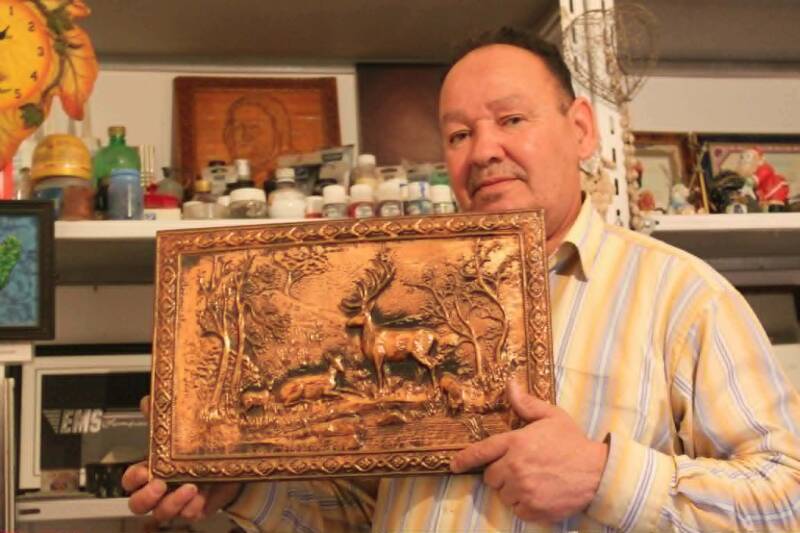
Algerian Artist Seid Denideni
I am considering launching a private school project to pass on the craft of copper embossing to the younger generation
Copper embossing in Algeria has its pioneers who sought to develop it through ornamentation. Today’s guest, artist Seid Denideni, bridges fine art and the copper craft, working as an artistic consultant.
He pioneered the creation of security badges on aluminum and copper, and has devoted nearly half a century of continuous dedication to this craft. He is currently planning to establish a private school to pass this heritage on to the youth.
How does he view the advancement of the craft he practices? How did he connect the grape painting to the agricultural occasion? And is copper embossing a free art or a restricted one?
Interviewed by: Turkia Loucif
---
1/ The revival of traditional industries is gaining traction among Algerian artisans, and your choice of copper and its decoration with various security badges is an innovative idea that distinguishes you among followers.
How did this industry evolve from Algerian households to commemorative paintings for security institutions?
_You know that copper craft holds deep-rooted heritage and a prominent place in the daily life of Algerian families. Many families in eastern Algeria have relied on copper craft as a commercial activity that generates income, and thus it has been passed down through generations. If you enter these homes, you will certainly find various copper utensils, but this has declined, possibly due to the spread of other metals such as stainless steel and aluminum.
You also know that the serving dish used on the Algerian table at feasts is known as "Tbsi Al-Ashaouat", but this plate is no longer used by modern families and has been replaced by pottery. It was traditionally used for serving couscous, but unfortunately "Tbsi Al-Ashaouat" has been abandoned.
As for the teapot "Al-Bagraj" - "Bag" means mouth in Arabic, and "Raj" means to shake with boiling water.
Regarding the copper security badges with different ranks, I was the first to innovate and produce certificates of honor and appreciation on metal after they had been on paper. I was also the first to create logos and badges for security institutions, and logos for public and private companies.
I specialize in embossing and hammering metals and precious metals, as well as wood, glass, wood turning, and engraving. My journey with this art spans 50 years._
2/ We are aware of your tendency to market your copper artistic products according to demand and specifications.
Do you ever feel restricted, given that an artist must remain free in creativity?
_Artistic freedom lies in how we express ourselves artistically, and it relates to freedom of imagination and creativity, and to disseminating diverse cultural expressions free from government censorship, political interference, and pressures from non-governmental private entities. That is the general definition. But the freedom we seek is the extent of independence of the artistic craft and its connection to the freedom of citizenship.
We extend artistic talent to all forms of artistic expression, and we participate with our art in public cultural life. We also provide readers with information on how to obtain copper ore from the earth, whether through open-pit mining or underground mining. This is done by vertical drilling to reach copper ore and driving horizontal tunnels toward the raw ore. Surface mining - 90% of ore is extracted through open-pit mining. Ores near the surface can be extracted after removing overlying layers..._
3/ Passing the craft from one generation to another through artistic workshops organized by cultural centers each cultural season.
Is this craft in demand for training? Have you received offers?
I heard about the "Art Market Reform Workshop" that was recently established as part of implementing the Ministry of Culture’s new cultural strategy. According to the economic perspective of culture, one of this workshop’s tasks is to seek "new working mechanisms that benefit both the artistic product and the cultural product." These products are integrated into the economic system based on market mechanisms, thus facilitating the marketing of artistic products. With such a workshop, the value of the artist is restored. As for workshops in cultural centers across 58 provinces, I still receive offers, and I am currently considering establishing a private school for copper art. However, passing this craft to youth and those interested remains scarce, if not non-existent, and I would be delighted to transmit this authentic artistic heritage to future generations.
4/Among your portfolio of copper paintings are works inspired by grape harvest occasions.
How is the copper painting connected to the occasion?
Since the dawn of history, humans have recorded aspects of daily life, religious rituals, and even fears on cave and rock walls. This act was considered a language of dialogue, and later engravings and drawings fascinated early humans and documented their life practices. Early humans expressed through them the nature of their thought and life over time. Thus heritage was formed and inherited by generations, because no civilization emerges from nothing. Therefore, heritage is the hallmark of a people’s existence and living proof of history’s vitality, linking past to present. Heritage is not static; it interacts, evolves, and adds to civilization’s achievements in every era. What I addressed in the painting is the grape cluster, and Algeria has vine estates, with Medea Province being one of the leading regions in producing this crop. From my personal perspective, reviving heritage is everyone’s responsibility, and I thank God that I feel fulfilled for leaving my own mark in copper embossing across the homeland in an artistic journey spanning half a century.
5/Your efforts in copper embossing, especially in paintings of Amazigh jewelry, deserve recognition.
_All my embodied artworks, whether on copper or aluminum, are distinctive and meticulously handcrafted with high precision, and no one can deny that.
I also emphasize the importance of educating youth on artistic taste and instilling an appreciation for the value and authenticity of comprehensive Algerian art in acquisitions and décor. I hope businessmen will contribute to "promoting" these Algerian artistic creations, especially copper paintings. Every Arab country has its customs and traditions that define it, but in Algeria, the continent-country, you find in every province and region customs and traditions that differ from others. These were once confined to families and homes, with each family having a specialty. Their products were used in daily life, and surplus was marketed in village markets or bartered for goods from neighboring regions.
Today, thanks to development and sound governance, the state has established chambers for traditional industries and crafts affiliated with the Ministry of Tourism in every province, as well as artistic institutions, to highlight traditional art, craft, and Algerian heritage so it may flourish and gain presence both in Algeria and abroad._
6/How can we elevate copper industry in cultural forums?
_The competent authorities entrusted with transferring artistic expertise and experiences for the purpose of developing and preserving them must enhance creative capacities in Algeria’s traditional and craft industries sector.
First, resorting to intellectual property rights - applying this to traditional copper industry because the world around us is advancing toward creativity. Our present is the culmination of the past and a starting point for every creative individual who coexists with the process of making the artistic product. Therefore, one can resort to property rights to protect new products and safeguard them.
And commercial exploitation control, because there is the World Intellectual Property Organization with its legislations and regulations. For this reason, societies have decided to allocate specific property rights such as designs, which are aesthetic creations related to the appearance of products._
At the end of our interview with you... What is the secret behind naming the copper painting "kharbasha"?[scribble]
_I seclude myself in my workshop for hours, and a visiting friend comes while I am busy embossing copper and transferring a design, until I hear my friend asking about this craft, so I reply: "It's just a scribble" to avoid lengthy conversation that makes me lose focus. And every time I finish a painting, I photograph it, post it on my account, and write "kharbasha"